
Eagle Pass City Directory Sources
A formal Eagle Pass city directory run has not been verified in an official catalog or library collection page. That matters. The Texas State Library city-directory holdings page was checked, but the inspected material did not establish a local Polk run, a publisher, shelf call number, or years of coverage. Treat a request for a city directory as a reference question, not as proof that one exists. The Eagle Pass Public Library has catalog and reference links, while the Texas State Library and partner catalogs can help identify an actual volume before a visit or request.
| Collection | Years | Where held | Access |
|---|---|---|---|
| Formal Eagle Pass city directory | Not verified | Ask the library reference desk and state-library catalog | Possible name or address source only if a specific volume is confirmed |
| Eagle Pass Guide | Digital subset, 1893-1909 | UNT Portal to Texas History | Browsable OCR and page images for notices, advertisements, and local officers |
| Eagle Pass News-Guide | Digital subset, 1964-1984 | UNT Portal to Texas History | Browsable OCR and page images for later household, move, death, and organization leads |
| Maverick County microfilm | 1861-1926, record dependent | Texas A&M International University in Laredo | Reel or archive access for land, tax, marriage, probate, and naturalization trails |
Call the Eagle Pass Public Library before relying on its posted schedule, because the city page and the separate library site show different hours. Ask whether a particular city-directory, criss-cross, newspaper, yearbook, or obituary file is held, and write down the title, year, and shelf or reel number. A blank catalog result is not evidence that no local copy survives.
Eagle Pass Guide City Directory Clues
The Eagle Pass Guide collection at the Portal to Texas History is the strongest remote substitute when a formal directory cannot be confirmed. The title began in 1888, and the currently described digital subset spans 1893 through 1909. It contains 152 issues and 1,202 pages across five represented years. Those figures describe the digitized holdings, not a complete newspaper run or a city directory.
The Guide is especially useful for a surname with a rough date. Search full and shortened names, Spanish and English given-name variants, compound surnames, a street name, or an organization. Then read the image, not just the OCR. A sample June 1, 1895 issue includes a section labeled “Directory” with court and transportation information, but it is a newspaper directory-style feature, not a household list. The UNT finding aid identifies rare Guide copies in collection AR0900, dated 1887-1938, and connects them to editor and publisher Joseph Boehmer's estate.
The Portal title page for the Eagle Pass Guide shows the digitized title's browse controls and holdings summary.
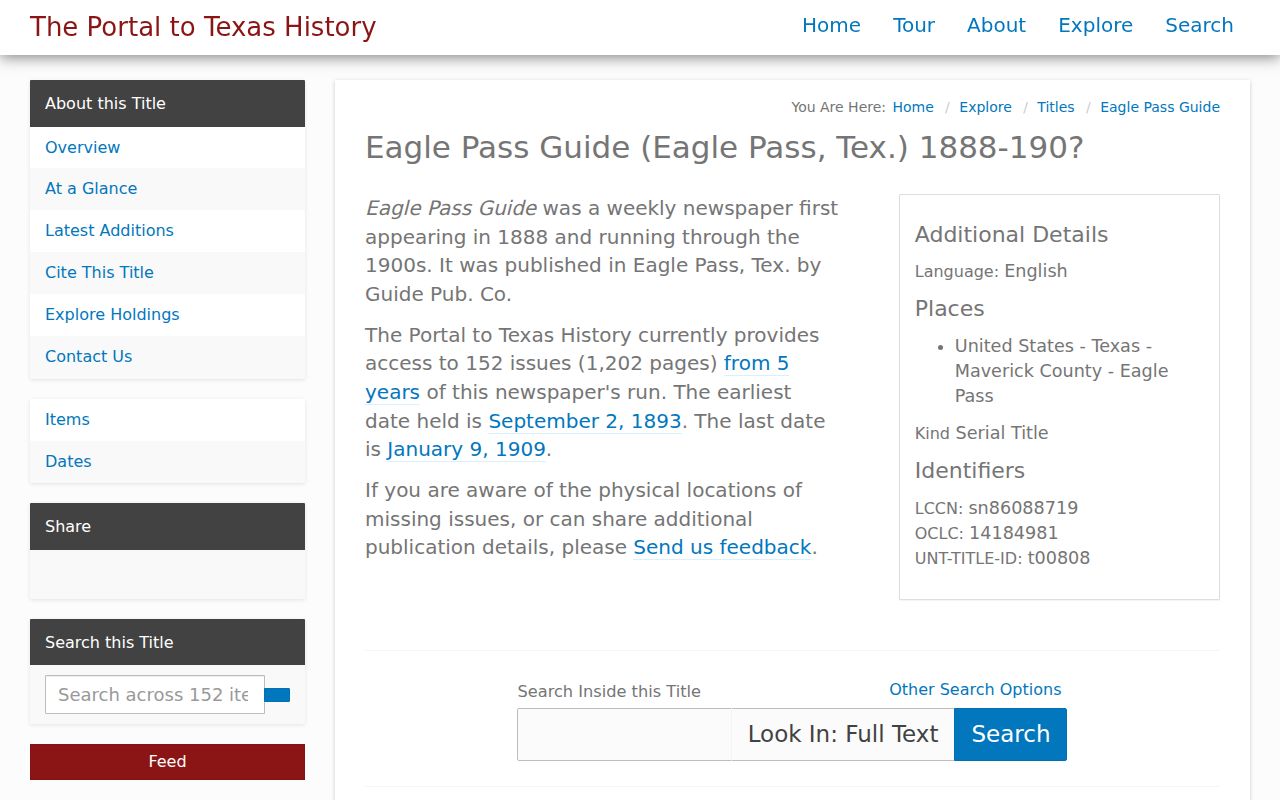
It supports a newspaper-led city directory search, while also making clear that no verified digitized Eagle Pass directory scan was located.
Eagle Pass News-Guide City Directory Window
The later Eagle Pass News-Guide collection gives a second, limited window for city directory research. The weekly title first appeared in 1948 and continues as a title, but the described online subset has 24 issues and 409 pages from seven represented years, with dates from March 26, 1964, through December 6, 1984. Use it to place a household in a period, not to claim continuous coverage between those dates.
Search for a death notice, marriage announcement, business advertisement, club item, or address mention. The same person can appear under a maiden name, an accented or unaccented surname, initials, or an OCR error. Save the issue date and page image with every find. Newspaper evidence can establish a lead, but it should be paired with a census, deed, probate record, or another independent source before it becomes a family conclusion.
Note: A digitized title is a selected group of issues, so absence from a Portal search does not prove that a person left Eagle Pass.
Reading Eagle Pass City Directory Evidence
A verified Eagle Pass city-directory sample has not been inspected, so local abbreviations, owner marks, and reverse-section labels cannot be stated as facts. When a real volume appears, begin with its publisher's key and cross-reference pages. In many historical directories, an alphabetical entry may include a name, address, occupation, spouse notation, widow or widower notation, workplace, telephone, or a house and roomer abbreviation. Those are reading hypotheses until a local scan proves the volume's conventions.
| Name | Record the spelling, initials, and any alternate surname exactly as printed. |
|---|---|
| Address | Keep the number, street form, and year, then compare it with a plat or map before treating it as a modern address. |
| Occupation or organization | Use it as a differentiator for people with the same name, not as proof of a complete work history. |
| Spouse or widow notation | Capture it as a relationship clue and verify it with a marriage, death, probate, or census record. |
| Occupancy mark | Read only from the volume's own abbreviation key; no Eagle Pass-specific key was verified. |
- Criss-cross directory
- An address-first listing that can point from a street number to a listed occupant. No Eagle Pass-specific run or years were verified.
- Householder index
- A list organized around household heads or addresses, useful when a surname has several spellings.
- Abbreviation key
- The publisher's explanation of shortened labels. Photograph or transcribe it before interpreting a single entry.
Eagle Pass Microfilm Beyond City Directories
When a city directory cannot be located, the Texas State Library's Maverick County microfilm inventory supplies a more dependable historical shelf. Texas A&M International University in Laredo is the identified reel location. The inventory lists tax rolls for 1861-1910, deed indexes for 1871-1923, deed books beginning in 1871, marriages for 1871-1917, probate minutes for 1876-1913, and naturalization declarations for 1882-1906. These sources do not replace a directory, but they can place a name, property, family relationship, or taxable holding in time.
The present online land index is a separate system, shown as beginning July 29, 1992. That division is important for city directory work because a household trail can change repositories and search methods at the boundary. Contact TAMIU, the Texas State Library, or a FamilySearch center to ask whether a named reel can be viewed, borrowed, digitized, or searched. Do not assume that a reel is available online.
- 1861-1910: surviving tax-roll years offer property and taxpayer leads.
- 1871 onward: deed and deed-of-trust material supplies ownership and legal-description context.
- 1876-1913: probate minutes can connect estates, heirs, and property.
- July 29, 1992 onward: the online Maverick County land index becomes the documented starting point.
Eagle Pass City Directory Map Context
The Library of Congress Eagle Pass Sanborn item is a useful address bridge, not a resident list. Its April 1916 edition has seven sheets. It can show a street, building footprint, material, use, and block context when a name appears in a newspaper or old record. Compare the street label with the legal description and a recorded plat before connecting it to a current parcel.
Old Eagle Pass references may describe Fort Duncan, the old crossing, California Camp, or the Twohig townsite rather than a modern street number. No official local street-renumbering or renaming year was found. That gap is a reason to preserve the map sheet, place name, and record date rather than manufacture an address conversion.
Trace Eagle Pass City Directory Households
Build a household trail one year at a time. First, find a name or address in a confirmed directory, newspaper, or microfilm index. Next, put it beside the nearest available federal census year. Census schedules through 1950 are publicly available under the 72-year release rule, but they may use enumeration district and household order instead of a familiar modern address. Capture age, birthplace, occupation, and household relationships, then compare them with property or probate names.
- Write down the exact name, year, address or place name, and source image identifier.
- Search a nearby Guide, News-Guide, or confirmed directory year for the same name and surname variants.
- Pair the result with the closest 1900, 1910, 1920, 1930, 1940, or 1950 census schedule.
- Use a deed, tax roll, marriage record, or probate minute to test whether the household and property clues agree.
- Record uncertainty plainly when an address changes, an OCR result is unclear, or a city-directory run has not been verified.
A disappearance can mean a move, death, misspelling, unlisted status, or a missing issue. Search obituaries and probate minutes as closing evidence, but distinguish a relationship mentioned in an obituary from a legal heir established in court records. For a modern address-led chain, the Eagle Pass street directory keeps the current parcel and recorded-plat work separate from these historical collections.
Eagle Pass City Directory Gaps
The record story is fragmented by format as much as by date. Rare Guide copies came from Joseph Boehmer's estate, early county material is on reels in Laredo, and later newspapers are selected Portal holdings. No local historical-society holdings page, public cemetery database, verified reverse-directory run, or complete Eagle Pass city-directory shelf list was found in the reviewed sources. A precise source citation is more useful than a guessed run.
Use the collection title, date span, creator, reel or page identifier, and access date whenever possible. That approach preserves a workable research trail for family history, heir matters, property history, and civic curiosity without turning a partial index into a claim about every person in Eagle Pass.