
Eagle Pass Previous Residents by Era
Previous residents are best researched as an address timeline. Start with the current parcel, preserve its legal description, then move through the record set that covers the era in question. A current owner record may lead to a deed, but it does not prove that the owner lived on the site. Conversely, a census or newspaper may identify a household without proving ownership. The best result keeps the document type, date, and geographic unit with every connection.
| Source | Years it covers | Where held | What it can show |
|---|---|---|---|
| Maverick CAD parcel card | Current tax years | Public CAD search | Current owner, situs and mailing address, IDs, value, and deed-history summary |
| TexasFile County Clerk index | July 29, 1992 to current displayed records | Authorized online channel | Grantor, grantee, instrument, volume/page, legal description, type, and date |
| Deed index and books | Index 1871-1923; listed books 1871-1885 | TAMIU microfilm and clerk historical volumes | Earlier transfers, lot or tract, and title sequence |
| Tax rolls | 1861-1910 | TAMIU reel 115401 | Taxpayer, taxable property, valuation, and historical ownership lead |
| Federal census | 1790-1950 public | NARA, Census, FamilySearch, or library channels | Household, age, occupation, birthplace, relationship, and enumeration district |
| Permits and newspapers | Archive coverage varies; digital newspaper subsets documented | City Community Development and UNT Portal | Construction or remodeling clues, notices, moves, deaths, and organizations |
For a recent deed, begin online. For an earlier transfer, move to the county counter or microfilm. For a household question, add census and newspaper evidence after the address is anchored. The research did not verify Eagle Pass-specific city-directory or reverse-directory years, so ask the Eagle Pass Public Library reference desk for a title and year rather than treating a run as known.
Eagle Pass Previous Residents Start Here
Use the Maverick County Appraisal District search to freeze the present parcel before moving backward. The address route uses Street Number and Street Name, while the owner route accepts a last-name-first format. The CAD instructions say to omit prefixes, suffixes, and unit numbers from Street Name and to try only the street name when a formatted address fails. Save the Property ID, Geographic ID, Owner ID, situs address, mailing address, subdivision, lot or tract, tax year, and deed-history rows.
The situs is the physical parcel. The mailing address is where tax correspondence goes. A mailing address can be a post-office box, agent, company, former location, or out-of-town destination, so it is not proof of occupancy. CAD also warns that legal descriptions and acreage are appraisal information that should be verified. The legal description is the durable bridge when a house number changes, a road is described differently, or an old record does not use a street address.
Note: Preserve each parcel identifier and the access date, because a current card and an old deed answer different questions about the same Eagle Pass address.
Eagle Pass Previous Residents Deed Chain
The Maverick County Clerk performs the recording role for land documents. Its TexasFile search offers name, instrument number, volume and page, free-form reference, legal-description fields, and date-range routes. The visible result grid identifies county, date, type, grantor, grantee, book-volume-page or number, and legal description. A grantor is the party transferring an interest. A grantee is the party receiving it. That relationship is the key to moving through the chain without treating a street address as the only identifier.
- Open the CAD parcel card and copy the current owner, situs, Property ID, Geographic ID, legal description, and each deed-history row.
- Find the latest recorded transfer by instrument number or volume and page, then confirm the legal description in the County Clerk index or authorized image channel.
- Use the seller from that deed as a grantee search for the earlier acquisition, matching lot, block, tract, subdivision, or survey details.
- Repeat the transfer-to-acquisition sequence and record the date, document type, grantor, grantee, and reference for every link.
- When the online index stops, ask the clerk about historical books and use the listed microfilm index instead of assuming an online gap means title ended.
- Chain of title
- The ordered record of transfers connected by the same legal description, not a list of every person associated with an address.
- Legal description
- The lot, block, subdivision, tract, survey, or similar land wording that identifies the parcel more reliably than an old street number.
- Instrument number
- A document reference used to locate a recorded item. Keep it with the book and page when both appear.
Eagle Pass Previous Residents Before 1992
The online land index is documented as starting on July 29, 1992. For earlier previous-resident work, the Texas State Library Maverick County inventory identifies a deed-record index for 1871-1923 on reel 1016776 and deed books for 1871-1885 on reels 1016777 through 1016779. The deed-of-trust index covers 1871-1923 on reel 1016776, with listed books for 1871-1891 on reel 1016779. Texas A&M International University in Laredo is the identified microfilm location.
This is a change in custodian and method, not a complete break in the address story. Ask TAMIU, the Texas State Library, or a FamilySearch center whether a requested reel can be viewed, borrowed, digitized, or searched. County Clerk staff can also identify whether later original volumes fill a period not represented by the online search. The research does not support claiming that every historical image is downloadable.
The state-library holdings page documents the microfilm series and its reel inventory.
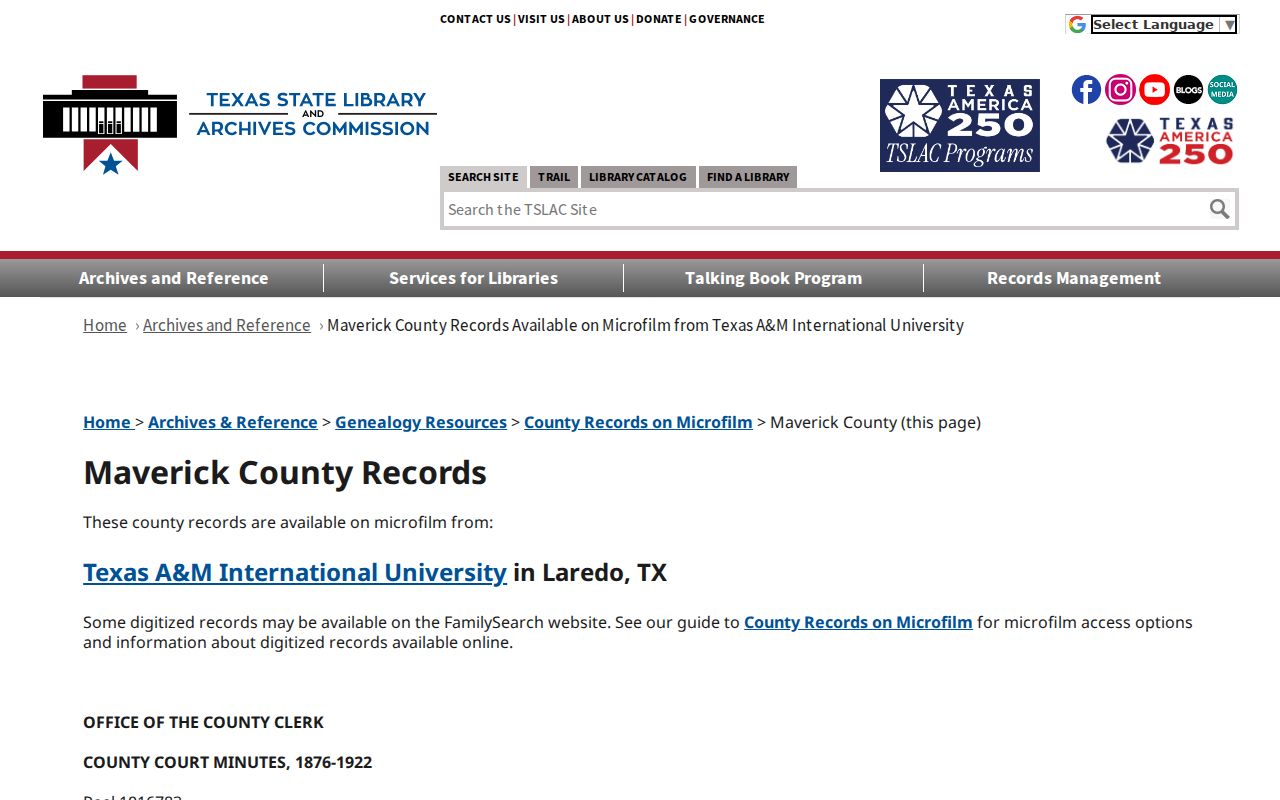
The reel listings supply the practical bridge from a modern parcel record to the historical deed, tax, probate, marriage, and naturalization trail.
Eagle Pass Permit Dates and Addresses
A building permit can help date a construction, addition, repair, demolition, or other change, but only when the city confirms that a completed record was issued and retained. The current Eagle Pass residential permit application asks for job address, MCAD Property ID, legal description, owner and contractor information, work type, square footage, project cost, description, and signature. Office fields include routing and permit-issuance information.
No public searchable permit database, completed permit sample, or retention schedule was verified. Request a narrow address, MCAD-ID, and date-range search from Community Development, and ask for both the application and issuance or inspection pages if they are retained. A blank form shows what an application may collect. It does not establish that a particular owner, contractor, or project exists at the address.
Eagle Pass Previous Residents on Maps
The Library of Congress April 1916 Sanborn map has seven sheets and gives building and block context for an old Eagle Pass address. It can show streets, structures, material, use, and the number of stories. It does not set parcel boundaries or name residents. Locate a sheet by street or landmark, then compare the map label with the recorded plat and deed legal description.
Maps work best beside a dated record. A 1916 building footprint, a 1900 census household, a newspaper notice, and a later deed each identify a different piece of the history. The city planning maps for zoning, flood, limits, thoroughfare, and historic preservation offer current regulatory context, but no official county parcel viewer with adjacent-owner tools was verified. Recorded plats remain the safer boundary source.
Note: Sanborn evidence helps date and place an address, but it cannot by itself identify who lived in an Eagle Pass building.
Eagle Pass Address Continuity Gap
Do not invent a street-renumbering bridge. Local history describes movement from Fort Duncan and the old crossing through California Camp to the Twohig townsite, yet no official street-renumbering, renaming, annexation, or address-conversion year was located. A present number may therefore fail to appear in a 1916 map or an older newspaper even when the underlying property is connected.
Use historic plats, Sanborn street labels, newspaper advertisements, city planning material, and deed legal descriptions to test the connection. Preserve the old place name beside the modern address rather than converting it by guesswork. Postal geography is another trap: 78852 can serve Eagle Pass and nearby rural pockets, while 78853 is associated with post-office-box service. A postal city line is not proof of a municipal boundary.
Eagle Pass Previous Residents Households
Past residents need a household layer after the title chain is established. Pair a confirmed address or nearby place name with the closest public census year, then use age, birthplace, occupation, and relationships to separate same-name people. Census schedules can be organized by enumeration district and household order rather than a modern address. Test Spanish and English given-name forms, compound surnames, absent accents, initials, and OCR errors in newspapers.
The Eagle Pass News-Guide digital collection contains a documented 1964-1984 subset, while the Guide and Eagle Eye offer other selected periods. Search a move notice, marriage notice, death notice, organization item, or business advertisement, then verify the original image. A formal Eagle Pass reverse or criss-cross directory run has not been verified, so it should be requested by title and year rather than assumed.
The News-Guide title page provides the browseable digital collection for these household leads.
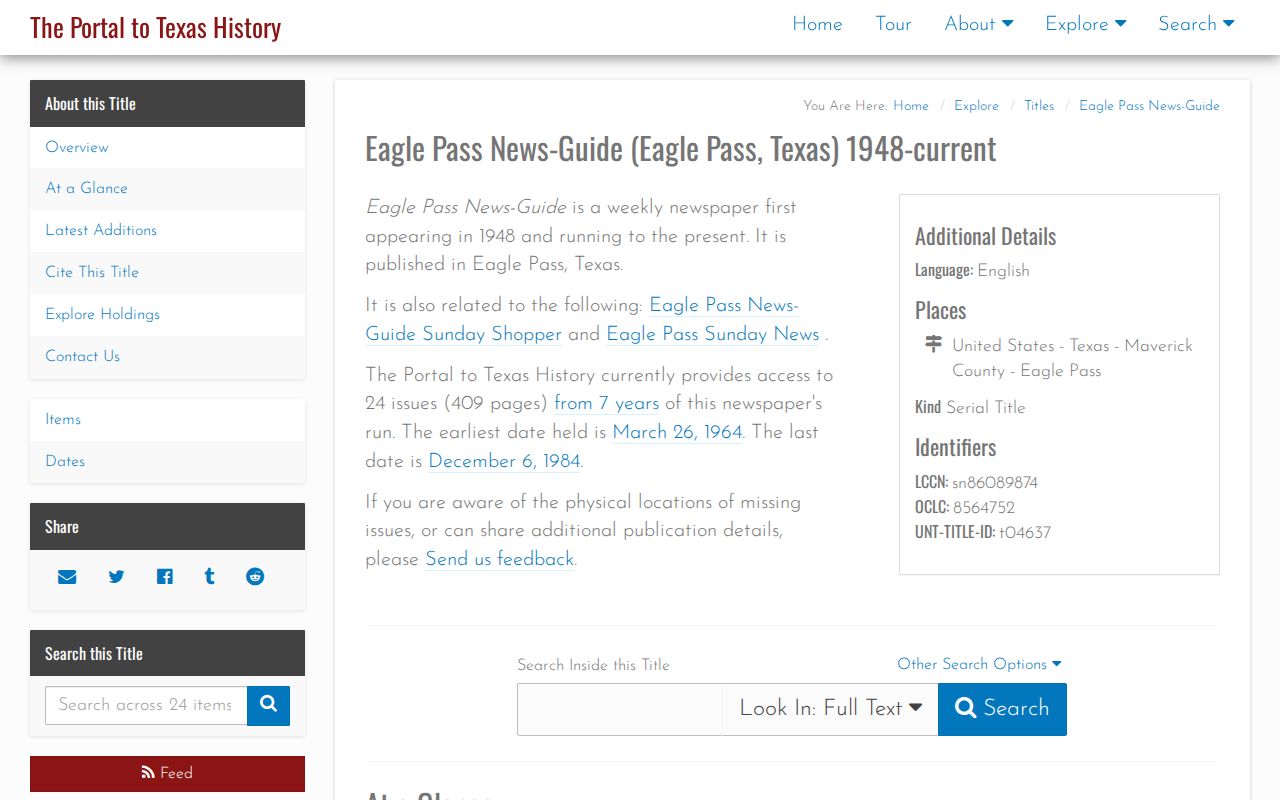
Its dated issue window helps place a newspaper result in the timeline, but it is not a full address directory.
Use death details and obituaries as leads to probate. Maverick County probate minutes on listed TAMIU reels cover 1876-1913. An obituary can identify surviving relatives, while probate, heirship, and a later deed are the records that can test legal succession. The historical collections themselves are described in the Eagle Pass city directory.
Lawful use. Use Eagle Pass address history for family research, property history, heir matters, or personal curiosity. Do not use records to track, threaten, or harass a living person; Texas law addresses stalking and harassment.